
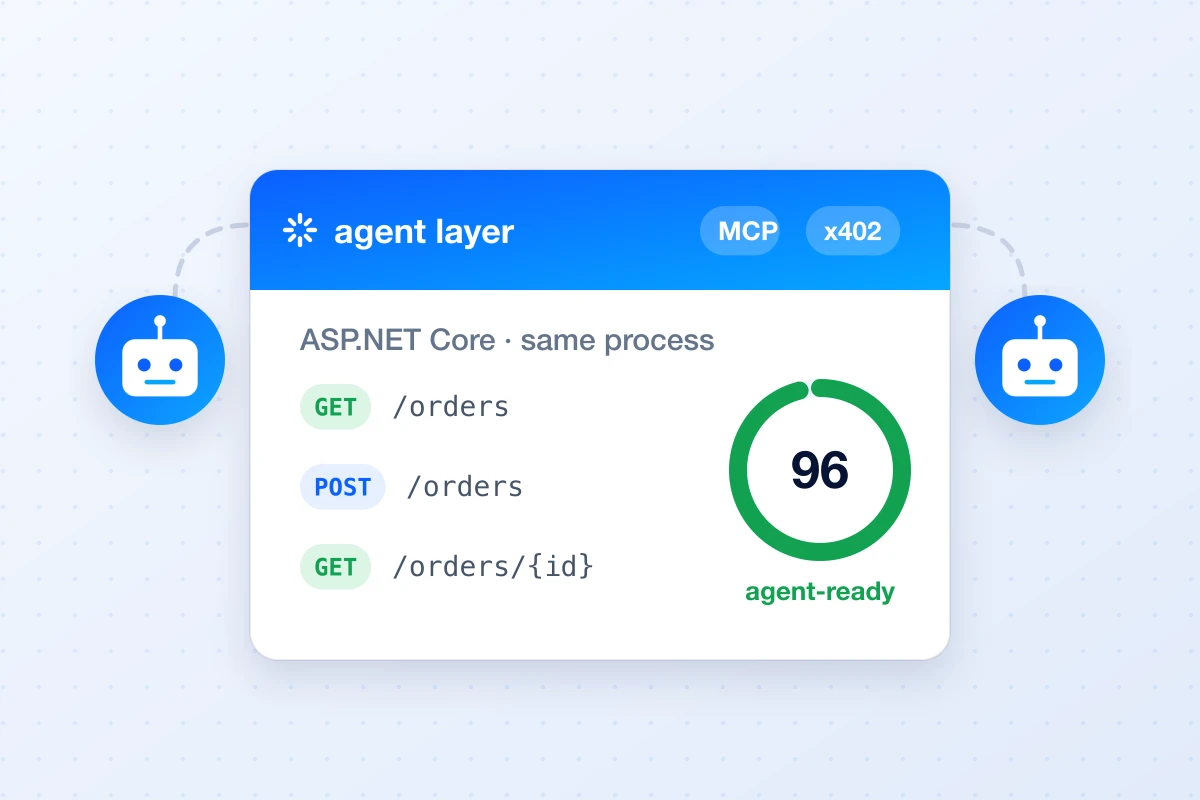
What is the Latitude 10 Agentify API for .NET (ASP.NET Core)?
Agents need to find your API, understand it, call it and maybe pay for it. That usually means writing an MCP server by hand, learning which discovery files agents look for, and deciding how to meter them. Agentify does it from the OpenAPI document you already have (a file, or the one your app already serves), inside the app you already run: there is no second server to deploy.
ASP.NET Core middleware for minimal APIs and MVC controllers, and the dotnet agentify tool. An agent’s tool call runs through your own pipeline, so your auth, [Authorize], validation and business logic are the ones already tested, and a minimal API keeps publishing with Native AOT. A readiness check tells you what a model will get wrong about your API before an agent does. It is the .NET edition of Agentify API for Node.js: the same documents, the same wire formats, the same readiness score. Code you own; .NET 10 or newer, with an OpenAPI document, and a database for persistent stores: SQLite, Postgres or SQL Server.
Want it installed for you? Ask for a fixed-price quote on the contact page.
You run this code and are responsible for it: review it, test it on staging, and check that it meets the laws, platform rules and security standards that apply to you before production. It is not legal, compliance or financial advice, and using it doesn’t make Latitude 10 your payment processor or service provider.
What do you get?
- An MCP endpoint (both MCP versions) with one tool per operation: reads on, writes off until you turn them on
- Tool calls run in-process through your own pipeline: routing, filters, [Authorize], your endpoints and controller actions
- Discovery from one document: llms.txt, the MCP server card, OpenAPI with agent hints, OAuth metadata, /.well-known/x402 and an /agent index, in the Node.js edition’s wire formats
- An agent-readiness score from 0 to 100 with fixes, the same score as the Node.js edition, and a command that drafts better descriptions
- No OpenAPI document yet? dotnet agentify draft adds ASP.NET Core’s own, made from your routes
- Agents use your API’s own credentials, agent keys, or OAuth, including Amazon Cognito machine-to-machine tokens; rate limits and usage metering for agent traffic
- Optional x402 pay-per-call for agents, settled only when your route succeeds; people with their own keys are never charged
- A minimal API stays Native AOT; SQLite, Postgres or SQL Server (Azure SQL included) stores
Every kit includes
- The full source code, yours to change
- A setup wizard: node setup.mjs, uv run setup.py for Python, or dotnet run setup.cs for .NET
- A versioned release with a changelog
- A download link that always serves the latest release
What's new in v1.0.0
- First release of the Agentify API for .NET, the .NET edition of the Agentify API for Node, at parity with its 1.1.0: ASP.NET Core middleware and the
dotnet agentifytool. The wire formats are… Agentify:MaxArgumentValues(default 10,000), Node 1.1.0'smaxArgumentValues: a tool call's arguments may hold at most that many values, counting every object, array, string, number, boolean and…- An MCP endpoint (both protocol eras) with a tool per operation, run in-process through your pipeline, and discovery documents:
/llms.txt, server card, AI Catalog, OAuth and x402 metadata,/agent. - On your routes: agent detection, agent keys, OAuth, rate limits, usage metering, x402 pay-per-call and
Idempotency-Key. Stores: memory, SQLite, Postgres, or SQL Server and Azure SQL. - The
dotnet agentifytool:initvendors the kit's packages (the tool's own too, so a clone or CI runsdotnet tool restore) intovendor/agentifyand sets upnuget.config, thendraft,…
What's in the zip
- latitude10-agentify-api-dotnet/
- latitude10-agentify-api-dotnet/.gitignore
- latitude10-agentify-api-dotnet/CHANGELOG.md
- latitude10-agentify-api-dotnet/Directory.Build.props
- latitude10-agentify-api-dotnet/Directory.Packages.props
- latitude10-agentify-api-dotnet/LICENSE.md
- latitude10-agentify-api-dotnet/Latitude10.Agentify.slnx
- latitude10-agentify-api-dotnet/README.md
- latitude10-agentify-api-dotnet/THIRD-PARTY-NOTICES.md
- latitude10-agentify-api-dotnet/VERSION
- latitude10-agentify-api-dotnet/examples/
- latitude10-agentify-api-dotnet/global.json
- latitude10-agentify-api-dotnet/packages/
- latitude10-agentify-api-dotnet/setup.cs
- latitude10-agentify-api-dotnet/src/
- latitude10-agentify-api-dotnet/tests/
How do you set it up?
dotnet run setup.csMakes a bundled Orders API agent-ready as a minimal API or with MVC controllers behind [Authorize], with no API key: installs the dotnet agentify tool from the kit’s own packages, scores its thin spec (54/100) and improves it to 96, serves every discovery document, connects the official MCP C# SDK in both versions, calls a tool through the API’s own auth, rate-limits an agent key, takes an x402 payment and prints the usage.
You'll need: The .NET 10 SDK (any feature band) and an ASP.NET Core 10 app, with minimal APIs or MVC controllers. An OpenAPI document: a file, or the one your app serves (Microsoft.AspNetCore.OpenApi, Swashbuckle or NSwag), or the one dotnet agentify draft adds. A store that outlives the process needs a database: SQLite, Postgres or SQL Server (the memory store is for development). Optional: an OAuth provider, a wallet address for x402.
Can an AI agent buy it?
An AI agent can buy this product for $39 on its own, paying in USDC over x402:
https://latitude10.tech/api/agent-products/agentify-api-dotnetOr through our MCP server at https://latitude10.tech/mcp with buy_product. How agent payments work →
When an AI agent buys from Latitude 10, the person or company that runs the agent is the buyer and accepts the Terms of Service. Payments on a blockchain or over Lightning are final. If a kit won’t run on a version listed on its page, tell us within 30 days and we’ll fix it or refund you in the same asset, to the paying address.