Latitude 10 Agentify API for Ruby on Rails
Make the Rails API you already have agent-ready. Same process, same deploy.
What is the Latitude 10 Agentify API for Ruby on Rails?
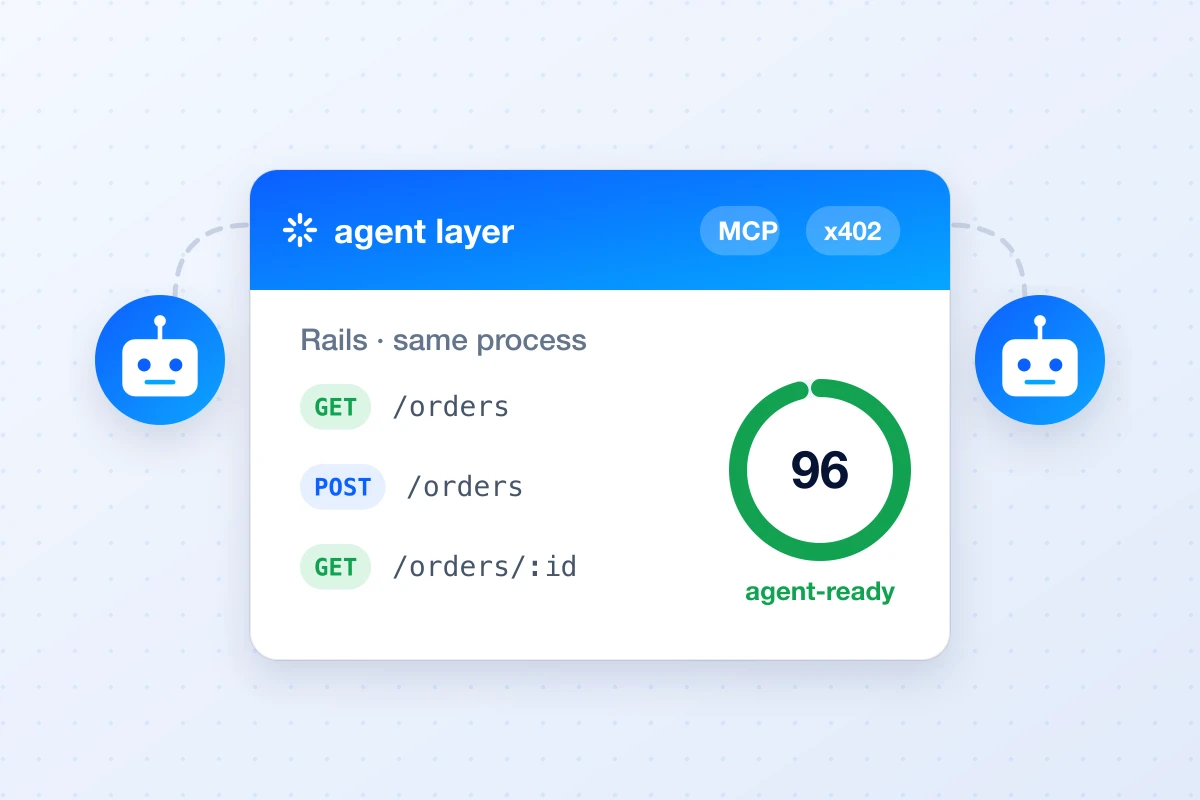
Agents need to find your API, understand it, call it and maybe pay for it. That usually means writing an MCP server by hand, learning which discovery files agents look for, and deciding how to meter them. Agentify does it from the OpenAPI document you already have (the one rswag or rspec-openapi writes, or a file), inside the app you already run: there is no second server to deploy.
A Rails gem on a framework-free core on Rack, and bin/rails commands. There is no code to add: a Railtie puts Agentify in your middleware stack, and an agent’s tool call runs through your own middleware, routes and controllers, so your auth, before_actions, validations and business logic are the ones already tested. It runs on Puma (threads, and clustered) and Falcon (fibers). A readiness check tells you what a model will get wrong about your API before an agent does. It is the Ruby edition of Agentify API for Node.js: the same documents, the same wire formats, the same readiness score. Code you own; Ruby 3.3 or newer and Rails 8.1, with an OpenAPI document from rswag, rspec-openapi or a file, and your app’s database for keys and usage: SQLite, Postgres or MySQL/MariaDB.
Agentify comes hosted or self-hosted. This kit is the self-hosted edition, inside the app you run. The hosted edition serves the same tools from your OpenAPI spec at a URL on latitude10.tech, free in a Latitude 10 workspace.
Want it installed for you? Ask for a fixed-price quote on the contact page.
You run this code and are responsible for it: review it, test it on staging, and check that it meets the laws, platform rules and security standards that apply to you before production. It is not legal, compliance or financial advice, and using it doesn’t make Latitude 10 your payment processor or service provider.
What do you get?
- An MCP endpoint (both MCP versions) with one tool per operation: reads on, writes off until you turn them on
- Tool calls run in-process through your own middleware, routes and controllers: your auth, before_actions and validations included
- Discovery from one document: llms.txt, the MCP server card, OpenAPI with agent hints, OAuth metadata, /.well-known/x402 and an /agent index, in the Node.js edition’s wire formats
- An agent-readiness score from 0 to 100 with fixes, the same score as the Node.js edition, and a command that drafts better descriptions
- No OpenAPI document yet? bin/rails agentify:draft adds rspec-openapi, which writes one from your request specs
- Agents use your API’s own credentials, agent keys, or OAuth; rate limits and usage metering for agent traffic
- Optional x402 pay-per-call for agents, settled only when your route succeeds; people with their own keys are never charged
- Puma (threads, and clustered) or Falcon (fibers); your app’s own database through Active Record, or a SQLite, Postgres, MySQL or MariaDB store of its own
Every kit includes
- The full source code, yours to change
- A setup wizard: node setup.mjs, uv run setup.py for Python, dotnet run setup.cs for .NET, java Setup.java for Java, ruby setup.rb --demo for Ruby, or php setup.php --demo for PHP
- A versioned release with a changelog
- A download link that always serves the latest release
What's new in v1.0.0
- First release of the Agentify API for Ruby on Rails, the Ruby edition of the Agentify API for Node, at parity with its 1.1.1 (rules 1.0.4): a Rails 8.1 gem,
latitude10-agentify-rails, on a… - An MCP endpoint (both protocol eras) with a tool per operation, run in-process through your own middleware, routes and controllers, and discovery documents:
/llms.txt, server card, AI Catalog, OAuth… - On your routes: agent detection, agent keys, OAuth, rate limits, usage metering, x402 pay-per-call and
Idempotency-Key. Settings inconfig/agentify.yml, theAGENTIFY_*variables and credentials.… - The
bin/railscommands:agentify:init,draft,check,improve,sync,keys,usageandmigrate, with Node's output, andagentify:prune;bin/rails generate agentify:migration; and a… - A setup wizard (
ruby setup.rb) that vendors the kit's gems into your project behind a Bundler path source, andruby setup.rb --demoon the bundled Orders API.
What's in the zip
- latitude10-agentify-api-ruby/
- latitude10-agentify-api-ruby/CHANGELOG.md
- latitude10-agentify-api-ruby/LICENSE.md
- latitude10-agentify-api-ruby/README.md
- latitude10-agentify-api-ruby/THIRD-PARTY-NOTICES.md
- latitude10-agentify-api-ruby/VERSION
- latitude10-agentify-api-ruby/examples/
- latitude10-agentify-api-ruby/setup.rb
- latitude10-agentify-api-ruby/vendor/
How do you set it up?
ruby setup.rb --demoMakes a bundled Rails 8.1 Orders API agent-ready behind its own token auth, with no API key and no wallet: installs the kit into a copy of it, scores its thin spec (54/100) and improves it to 96, boots it under Puma, serves every discovery document, connects an MCP client in both versions, calls a tool through the API’s own auth, rate-limits an agent key, takes an x402 payment and prints the usage.
You'll need: Ruby 3.3 or newer (3.3, 3.4 or 4.0) and a Rails 8.1 app, under Puma or Falcon, with Bundler 2.5 or later. An OpenAPI document: the one rswag or rspec-openapi writes, a file, or the one bin/rails agentify:draft sets up with rspec-openapi. Keys and usage live in your app’s database by default, through Active Record; a store of its own needs SQLite, Postgres or MySQL/MariaDB and its driver gem (sqlite3, pg, trilogy or mysql2). The demo needs RubyGems.org to install its Rails. Optional: an OAuth provider, a wallet address for x402.
Can an AI agent buy it?
An AI agent can buy this product for $39 on its own, paying in USDC over x402:
https://latitude10.tech/api/agent-products/agentify-api-rubyOr through our MCP server at https://latitude10.tech/mcp with buy_product. How agent payments work →
When an AI agent buys from Latitude 10, the person or company that runs the agent is the buyer and accepts the Terms of Service. Payments on a blockchain or over Lightning are final. If a kit won’t run on a version listed on its page, tell us within 30 days and we’ll fix it or refund you in the same asset, to the paying address.
Rather have it built for you? Our MCP implementation service uses these kits. →
More kits for Ruby
See all Ruby kits →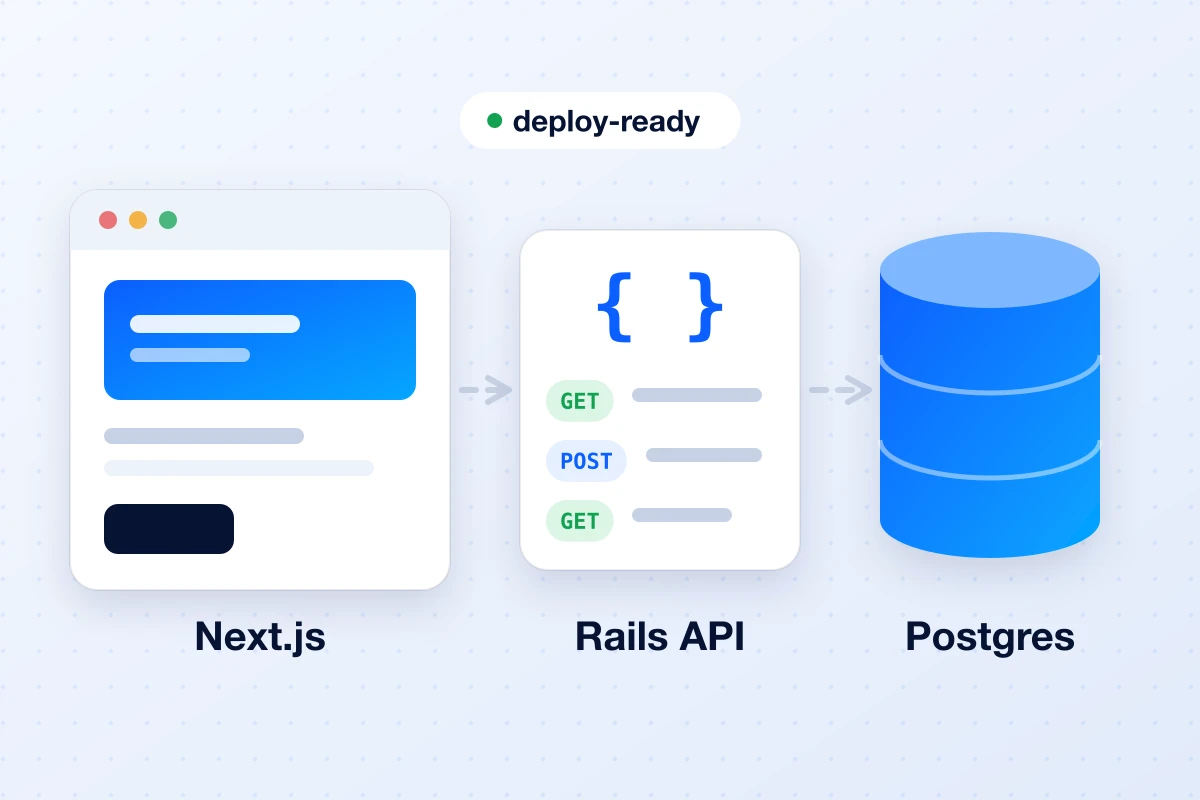
Latitude 10 Starter Kit for Ruby on Rails
A Rails API on Supabase Postgres and a Next.js frontend on Vercel, wired together and deploy-ready.